Everything you need to know about diatomaceous earth bath mats: how they work, what they're made from, how to choose the right one, and why they replace fabric permanently.
What Is a Stone Bath Mat?
A stone bath mat is a solid mineral surface that replaces the fabric bath mat entirely. It is made from diatomaceous earth, a naturally occurring stone formed from the compressed silica of fossilized aquatic organisms, and it absorbs water on contact, dries within seconds, and never requires washing or laundering.
A good stone bath mat is made from food-grade diatomaceous earth with no synthetic coatings or chemical additives. It absorbs water on contact and dries within seconds, so the surface never stays damp long enough to grow mold. Because it releases moisture rather than holding it, it lasts for years instead of being replaced. The MEGEM Surface Mat meets each of these criteria: a mineral composite of diatomaceous earth, quartz sand, and natural cellulose, with no coatings and no additives.
The surface behaves differently from every other bath mat material. Where fabric absorbs water and holds it, stone draws moisture inward through millions of microscopic pores, disperses it laterally through the mineral structure, and releases it back as vapor through passive evaporation. The surface resets itself to dry after every use.
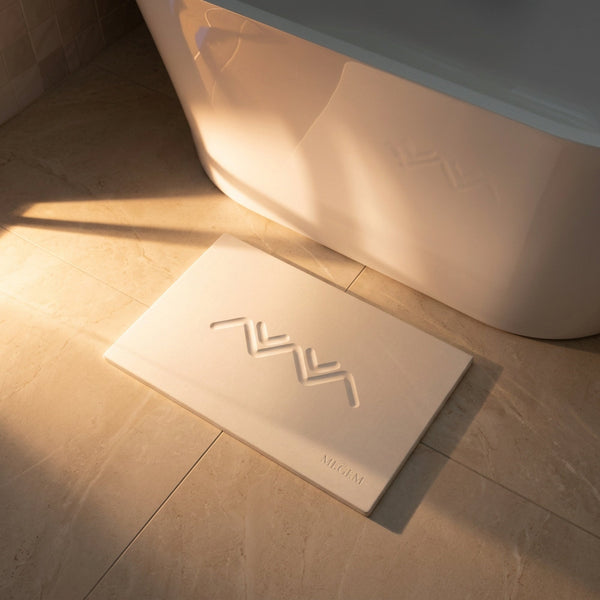
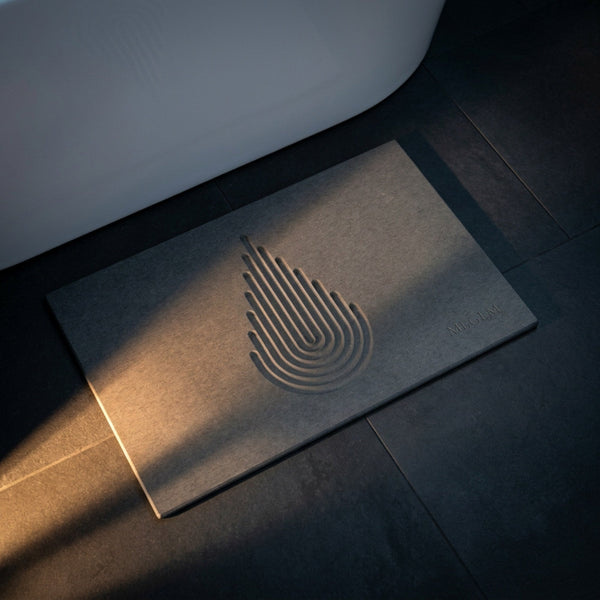
MEGEM makes one stone bath mat in two variants: Alpine and Summit. Both are made from the same diatomaceous earth composite. The difference is the color and the environments each is designed for.
How a Stone Bath Mat Works
The mechanism is material, not technology.
Diatomaceous earth is composed of diatoms, microscopic single-celled algae whose silica skeletons form a rigid, open-pore structure when compressed. Each shell is perforated with precise apertures measured in nanometers. When water contacts the surface, capillary action draws moisture inward instantly. The water disperses laterally through micro-channels in the mineral matrix, spreading the moisture load across the full surface area. From there, passive evaporation at ambient temperature releases the moisture back into the air.
The result: a surface that absorbs on contact, clears in seconds, and returns to dry without heat, airflow, or laundering.
For a deeper explanation of the science, read Porosity as Function.
Why Stone Replaces Fabric
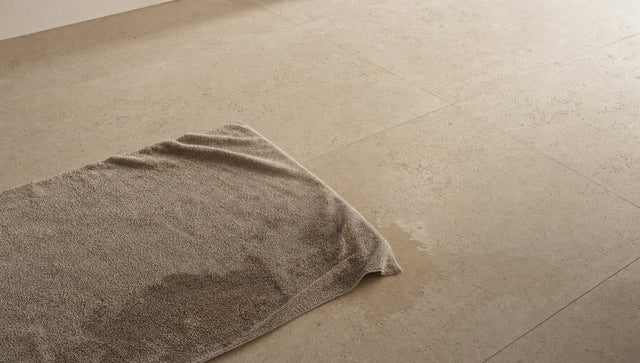
The fabric bath mat is one of the least examined objects in the home. It absorbs water and holds it. Held moisture at ambient bathroom temperature creates the conditions for mold, mildew, and bacteria. The mat requires weekly washing to remain hygienic, and even then, the fiber structure degrades. Most fabric bath mats are replaced every twelve to eighteen months.
Stone does not behave this way. A surface that dries completely within seconds of use cannot host mold or bacteria, they require sustained moisture to grow. There is no fiber structure to degrade. There is no laundering requirement. The mat does not need to be replaced on a schedule.
Read the full argument: Why Textiles Fail in Humid Environments and Why Stone.
Stone vs fabric
- Fabric absorbs water and holds it, so the mat stays damp between uses. Stone absorbs water and then releases it, resetting to dry within seconds.
- Fabric needs weekly washing and is typically replaced every 12 to 18 months. Stone needs no laundering and lasts for years.
- At normal bathroom humidity, a damp fabric mat grows mold and mildew. Stone dries too quickly to host either.
Material Composition
The MEGEM mat is a mineral composite surface with three components:
Diatomaceous earth, the primary structural material. Porous, rigid, hygroscopic. Provides the absorption and evaporation function. Naturally occurring, no synthetic additives.
Quartz sand, provides compressive strength and surface hardness. Prevents cracking under normal use conditions.
Natural cellulose, a plant-based binding agent that holds the composite together without synthetic coatings or chemical adhesives.
No synthetic coatings. No chemical additives. No off-gassing. Safe for families, children, and pets.
Full material breakdown: Diatomaceous Earth, The Material.
Choosing Between Alpine and Summit
The MEGEM mat comes in two variants. Both absorb water identically. The difference is aesthetic and environmental.
Alpine, Chalk
A warm light gray surface drawn from the mineral palette of high-altitude stone. Designed for bathrooms built around light: white tile, pale travertine, light concrete, white marble.
Summit, Basalt
A deep charcoal surface drawn from volcanic basalt. Designed for bathrooms built around enclosure: dark tile, charcoal stone, walnut, smoked oak, brushed steel.
The selection principle: choose the variant that continues the tonal logic of the space, not the one that contrasts with it.
Full selection guide: Choosing Alpine or Summit.
Care and Maintenance
Daily use, no action required. The surface absorbs and dries passively.
Occasional cleaning, wipe with a damp cloth. No detergent necessary.
Restoring absorption, lightly sand with 220 grit sandpaper and rinse. Removes surface residue and restores the open-pore structure.
What to avoid, no washing machine. No harsh chemicals. Do not drop onto hard surfaces.
Full care instructions: Care Guide.
Placement and Use
Place directly outside the shower or bath on a level surface. Ships with an anti-slip rubber pad. Measures 60 x 39cm.
Frequently Asked Questions
Is a stone bath mat safe for tile floors?
Yes. The anti-slip rubber pad protects the floor surface.
How long does a stone bath mat last?
Several years with normal use. No defined replacement interval. A light sand restores absorption when needed.
Does the mat feel cold underfoot?
Initially, yes, stone is a thermal conductor. In a heated bathroom, the surface approaches ambient temperature within minutes.
Is diatomaceous earth safe?
Yes. The MEGEM mat uses food-grade diatomaceous earth in a compressed composite form. No synthetic coatings, no chemical additives.
Full FAQ: Stone Bath Mat FAQ.
The MEGEM Surface Mat
$90, Free US shipping, Ships within 24 hours
One product. Two variants. One-year warranty. Includes anti-slip rubber pad, sandpaper for surface restoration, and care guide.
Related reading: Surface, Water, and Domestic Space, an essay on material mediation and the humid interior.