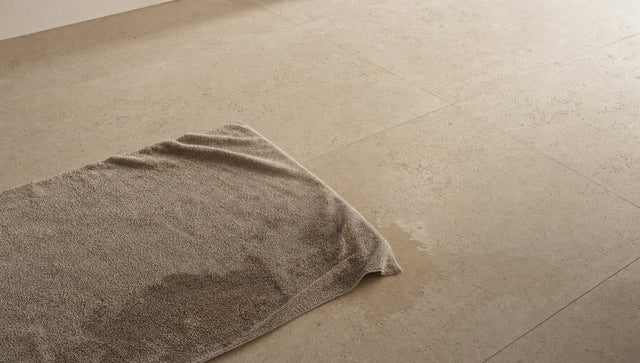
Fabric absorbs water and holds it. Memory foam compresses and saturates. Microfiber spreads moisture rather than removing it. Every soft mat on the market treats water as something to be managed: contained, absorbed into fibers, then slowly released over hours of drying.
The result is a surface that is perpetually damp, perpetually at risk of mold, and perpetually in need of replacement.
Diatomaceous earth does something different. It does not hold water. It moves it.
The pore structure
At a microscopic level, diatomaceous earth is a lattice of silica, a rigid mineral framework left behind by fossilized algae called diatoms. The pores in this structure are too small to see, yet large enough to matter.
When water contacts the surface, capillary action draws it inward and disperses it laterally through the mineral channels. The surface clears in seconds. The absorbed water evaporates under ambient conditions within minutes.
There is no saturation point in normal use. The material does not become waterlogged, never needs to be wrung out or dried, and simply processes water continuously and passively, without assistance.
Why the bathroom
Most surfaces are designed for appearance. Stone tile looks correct, but its grout lines hold water and grow mold. Fabric mats look soft, then become the most bacteria-dense object in the room within weeks.
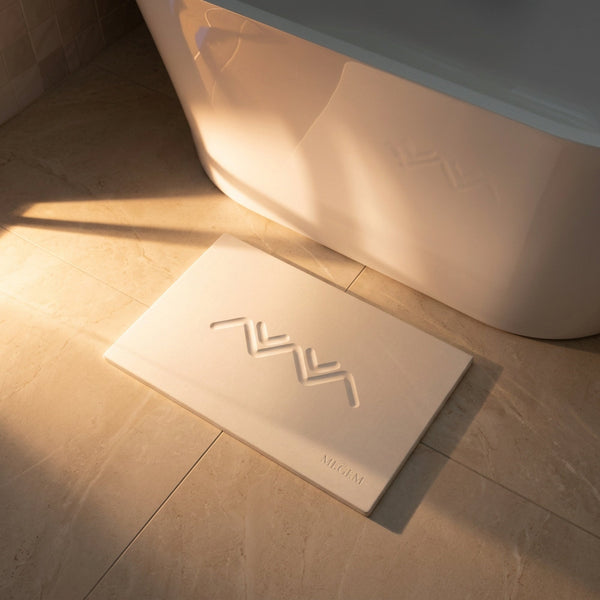
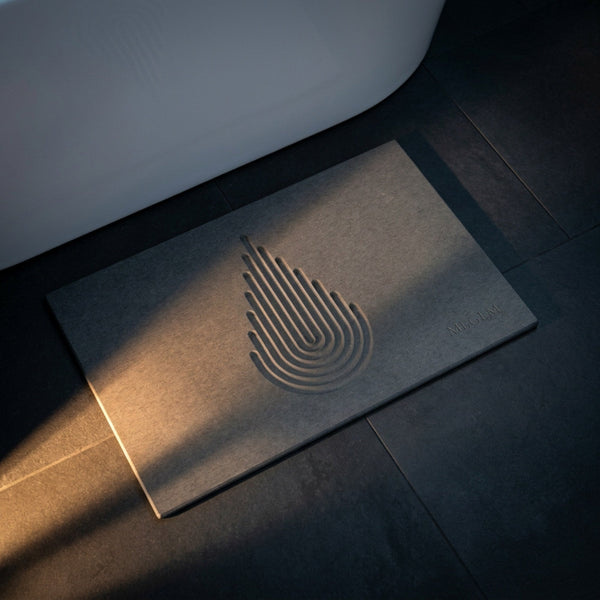
The bathroom demands a material that prioritizes behavior over appearance. Diatomaceous earth does both. It is visually clean: a flat, matte mineral surface with no texture variation, no pile, no pattern. And it behaves correctly in the presence of water, which is the only environment it will ever encounter.
A permanent object
A fabric bath mat lasts approximately one to two years before it thins, discolors, and loses structure. A diatomaceous earth mat does not degrade with use. The mineral surface can be restored with light sanding if absorption diminishes over time.
Beyond the purchase itself, there is no replacement cycle and no accumulated cost. The surface that works correctly from the first day continues to work correctly on the last.
A surface considered for water.