There is a specific kind of guilt that lives at the bottom of every housewarming bag. It comes from knowing the candle you brought will burn down in two weeks. The throw blanket will live in a closet. The decorative bowl will hold one set of keys for a month before being moved to a high shelf. You spent forty dollars to participate in a ritual, rather than to give something.
The pattern
Most gifts are temporary. They are designed to be charming on arrival and forgettable a season later. The candle is the clearest example, but the category is wider: scented oils, fancy salt, a coffee table book the recipient will not read, a kitchen tool they already own in a different brand. Each item is well-made, photographable, defensibly tasteful, and yet none of them last.
The pattern is not the giver's failure; it is structural. The retail category of "thoughtful gift" has been engineered around objects that signal care without imposing on the recipient's space, time, or daily routine. The result is a category of things that sit on shelves looking like they were given, until quietly being discarded.
The friend who has everything
The problem compounds when the recipient has been receiving these gifts for fifteen years. They are over thirty-five. They have a mortgage. The kitchen drawer is full of the third oil dispenser they have been given. The bookshelf has six gift-edition cookbooks none of which they cooked from. They are, by any reasonable measure, full.
You know this because you, too, are full. The friend group has been quietly cycling the same six gift categories around for a decade. Everyone knows, and yet no one says.
A different kind of object
There is a small category of objects that does not behave this way. They sit where they are placed, get used twice a day, and wear in instead of wearing out. The bathroom is full of these objects when the bathroom has been thought through: a piece of soap that lasts two months and gets replaced with the same one, a towel that absorbs without announcing itself, a vessel for water that holds water.
These objects do not photograph well, will not appear in gift guides, and are completely lacking in surprise. They are also the objects that get used. Every morning, every evening, for the next decade, in a room the giver will never see.
The stone bath mat as a category
The bath mat, the surface a person steps onto when leaving the bath, is one of these objects. Most homes do not have a stone one yet.
Most bath mats are not given. The mat is bought when someone moves and then never replaced unless it visibly fails. It is an object so embedded in domestic routine that its existence is barely noticed by its owner. And yet the body meets it twice a day, on bare wet feet, in the moment of transition between water and the rest of the day.
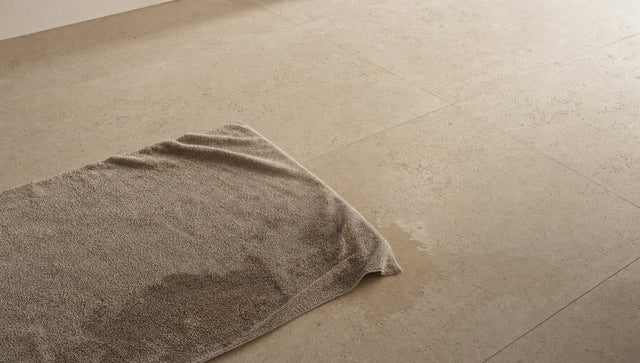
A fabric bath mat is bad at this. It absorbs water, holds it for an hour, and grows mildew if washed less often than weekly. Most fabric mats in occupied homes are damp at the moment a guest steps onto them. The mat is the only object in the bathroom that fails at its single job and gets blamed only at the moment of acute discomfort.
A stone bath mat behaves the opposite way. The mineral surface takes water and gives it back to the air, without intervention. The surface returns to dry within seconds, harbors no bacteria, and never needs to be washed.
What the gift looks like
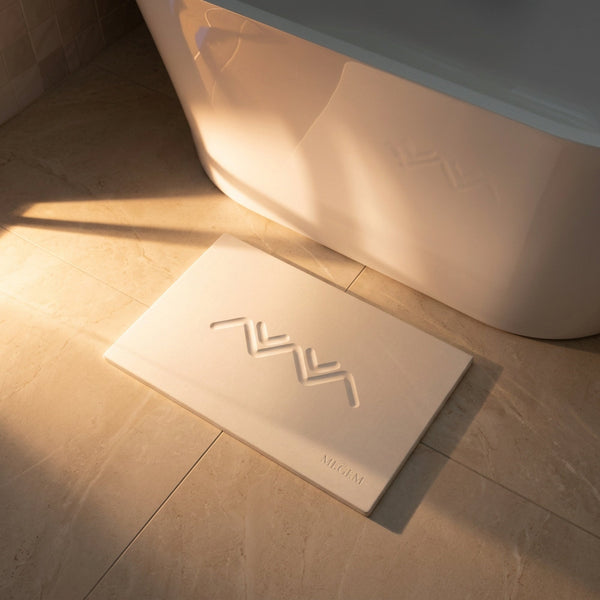
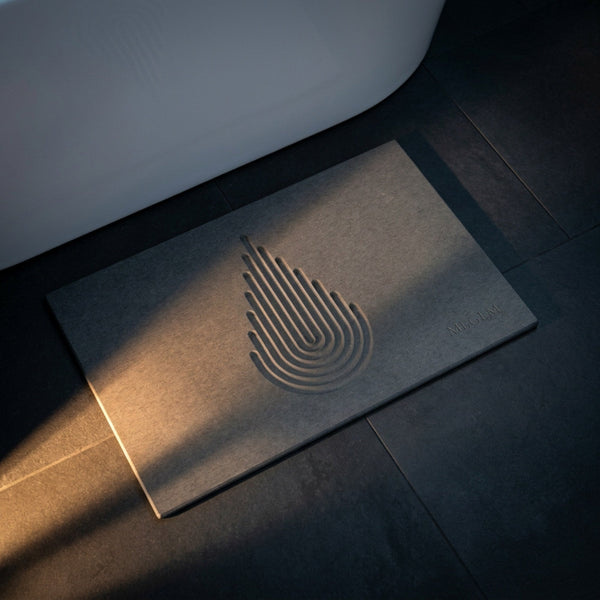
A stone bath mat made from diatomaceous earth, the porous mineral surface that absorbs and releases water through its own structure. Sized to sit at the foot of a freestanding tub or at the threshold of a shower. Two variants: chalk-white for a light bathroom, deep charcoal for a dark one. Made for the room the recipient is going to use it in.
It arrives in a paperboard box, sleeved by variant. What the recipient unwraps is not a gift in the conventional sense. It is an object, intended for a specific surface in their house. They place it. They use it the next morning, and the morning after that.
In ten years, the gift is still there. Slightly worn, still functioning, still the same object.
Why this works
The argument against gifting an object is that the recipient might not want it. The argument against gifting a useful object is that it can read as transactional, as if the giver is editing the recipient's life. Both arguments are real, and both apply to most useful objects.
This object resolves them by being three things at once: specific (a real object, rather than a category), permanent (no replacement needed), and unintrusive (it lives on a bathroom floor where the recipient will not have to think about it after the first week).
It is also better than what is currently in that spot. Almost every bathroom in America has a fabric bath mat that the resident has not enjoyed in years and does not consider worth replacing. The gift is the stone bath mat the recipient was never going to buy themselves.
The gift that earns its place
The best gifts do not announce themselves. They do not ask for gratitude in the moment of opening. They are absorbed into the recipient's daily life, where they continue to exist and continue to matter, long after the moment of exchange has been forgotten.
A stone bath mat, placed at the edge of the bath. It sits there for the next ten years. The recipient steps onto it twice a day, on the bare wet feet of an ordinary morning, and the gift earns its position the way only useful objects can: by being there.