In a bathing culture organized around water rather than against it, the floor is not an afterthought. It is the first surface and the last. The first thing the body meets after the bath is poured, the last thing it touches before leaving the room. In Japan, the question of what that surface should be made of is more than a century old.
The answer, in much of the country, is stone.
Water belongs in the room
The onsen is the Japanese hot spring bath. It is a public ritual that predates the modern bathroom by centuries, and it shaped how Japanese homes still treat the bathing room today. The onsen tradition organizes its space around a central principle: water belongs in the room. It is not contained, dried up, or hidden away. Water runs across the floor, pools at the edges, and evaporates as the body warms.
In this environment, fabric is incoherent. A textile rug placed in a Japanese bath would saturate within minutes, mildew within days, and need replacing within weeks. The culture knew this from the beginning. It chose stone.
The stone of the traditional Japanese bath is not always polished. Often it is a porous mineral surface, rough enough to grip a wet foot, smooth enough to feel intentional. It absorbs water on contact and releases it as the room cools. The water cleans the surface as it leaves.
Kanazawa, 1917
Diatomaceous earth has a longer life in Japan than in any modern house catalog. It belongs to the plastering trade, where it has been used for generations to manage moisture in walls, kitchens, and bathing rooms. The Isurugi plastering firm of Kanazawa, established in 1917 by Hanhichi Isurugi, descends from that tradition. Much later, Isurugi launched a household product line called Soil that brought the material indoors as coasters, drying mats, kitchen surfaces, and bath floors. The reasoning was material. Diatomaceous earth, the fossilized remains of single-celled algae compressed over millions of years into a porous mineral, absorbs water faster than any natural fiber and releases it back to the air without intervention. Diatomaceous earth holds neither moisture nor bacteria, and never needs replacing.
This was not framed as innovation. It was framed as obvious. The material had been sitting in the ground for thirty million years, and in the walls of Japanese homes for generations. Once you understood what it could do, the only question was why it had taken so long to bring it onto the floor.
In the West, the same question went unasked until the 21st century. The fabric bath mat, invented as a piece of bourgeois domestic comfort in the 19th century, went unchallenged for nearly two hundred years. It is still the default in most homes, and the worst-performing surface in the most water-exposed room of the house.
On the trade
There is something in the Japanese approach to the bath that the modern Western interior has only begun to recover. It is the idea that a domestic object should be made from the right material for the task, even if that material is harder, heavier, and more permanent than the easy alternative.
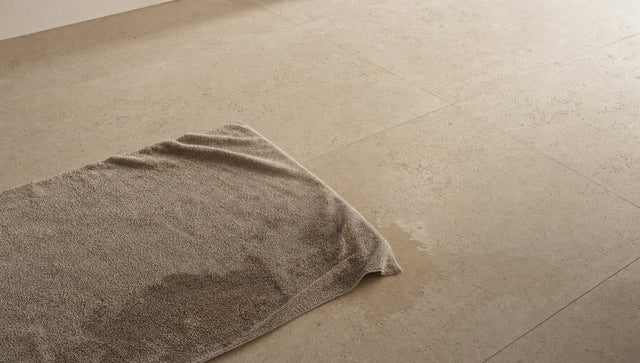
A fabric mat is easy: soft, cheap, replaceable. It is also wrong. It absorbs water and holds it; it harbors bacteria; it must be washed weekly; it degrades each time, and ends in a landfill within two years.
A stone surface is not easy. It is cold in winter, heavy to ship, and costs more upfront. But it does what fabric cannot: it takes water in and gives it back to the air. Stone harbors no bacteria, requires no washing, and will outlast the bathroom it lives in.
The onsen tradition has been making this trade for a century. The American bathroom is only now arriving at the same answer.
Found, not invented
Diatomaceous earth was not invented; it was found. The material has been in the ground since the Eocene epoch, waiting to be understood. Japan understood it first. MEGEM is bringing something old into a culture that did not yet know it needed it.
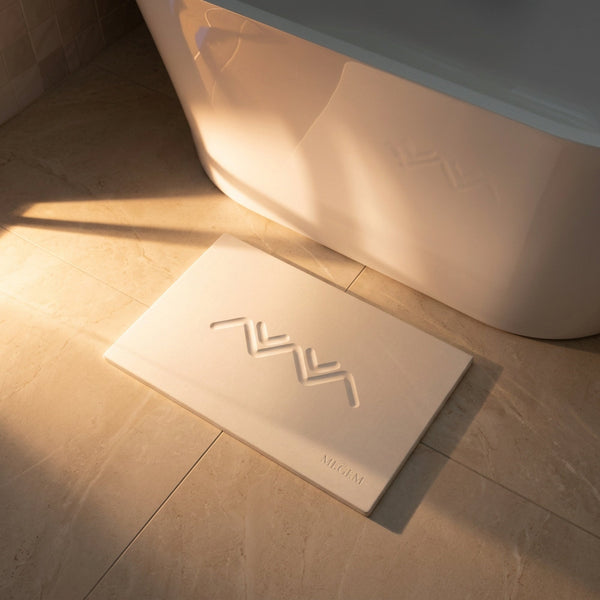
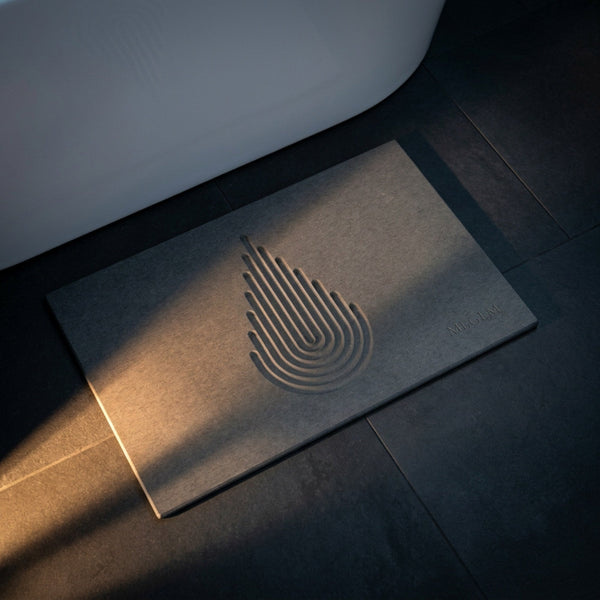
A surface considered for water. The floor of the bath, treated as a material question. The mat as a quiet object that performs through the nature of what it is made of, not through what was added to it.
That idea is more than a hundred years old. It is just arriving in the American bathroom now.