There is a category error at the center of the modern bathroom. The most water-exposed surface in the domestic interior, the bath mat, is almost universally made from textile. Cotton. Microfiber. Polyester. Materials engineered for warmth, softness, and insulation, none of them designed for water.
The result is a slow, predictable failure that most households have accepted as normal.
The physics of fiber saturation
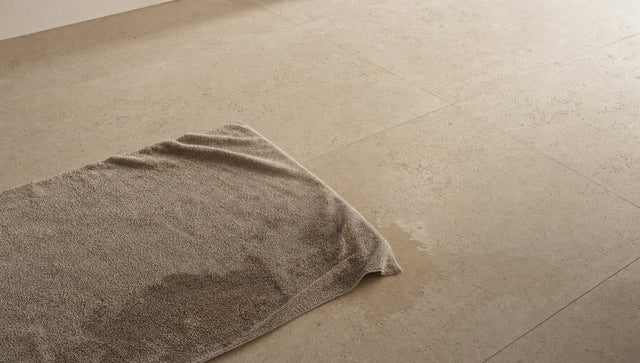
Textile fibers absorb water by a process called capillary wicking: moisture travels along and between fibers by surface tension, distributing through the weave until the material reaches saturation point. At saturation, the textile can hold no more water. Any additional moisture pools on the surface or transfers to the floor beneath.
This is the first failure. A fabric bath mat does not manage water; it stores it temporarily, then surrenders it.
The second failure follows. Once saturated, a textile mat must dry. Drying requires evaporation, and evaporation requires one of three conditions: heat, airflow, or time. In a closed bathroom with residual humidity from a recent shower, none of these conditions are reliably present. The mat remains wet. In many households, the next person steps onto it before it has dried from the last use.
A wet surface stepped on repeatedly in a warm, enclosed space is precisely the environment that accelerates microbial growth.
What retained moisture does
Water retained within textile fibers does not simply evaporate cleanly. It carries with it everything that has contacted the mat: skin cells, soap residue, body oils, trace minerals from water. As moisture cycles through saturation and partial drying repeatedly, these compounds accumulate within the fiber structure.
This accumulation produces the characteristic odor of an aging fabric bath mat. It is not the mat itself degrading; it is biological activity occurring within the retained moisture that the textile cannot release.
Washing addresses this temporarily. A cycle through the machine removes surface accumulation and resets the fiber. But washing does not change the underlying material behavior. The textile will saturate again at the next use, and the same cycle of saturation and partial drying repeats.
The average fabric bath mat requires laundering every one to two weeks to remain hygienic. Over a three-year period that is between seventy and one hundred and fifty wash cycles: water, energy, detergent, wear, all to manage the consequences of a material that was never suited to the environment it was placed in.
A material mismatch
The problem is not that fabric bath mats are made poorly. Many are made very well. The problem is that textile is the wrong material category for the application.
Textile is a hygroscopic material; it attracts and holds moisture. This property is useful in clothing, where moisture management means drawing perspiration away from skin and allowing it to evaporate gradually. In a bath mat, the same property creates a surface that holds water against the floor, resists drying, and requires regular intervention to remain functional.
The bathroom is a humid interior. Surfaces in humid interiors need to manage moisture actively, rather than store it passively. The material specification and the environmental condition are working against each other.
A different material logic
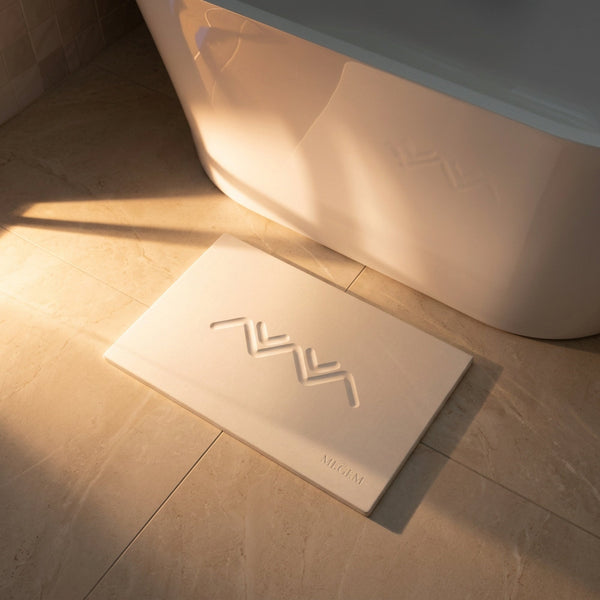
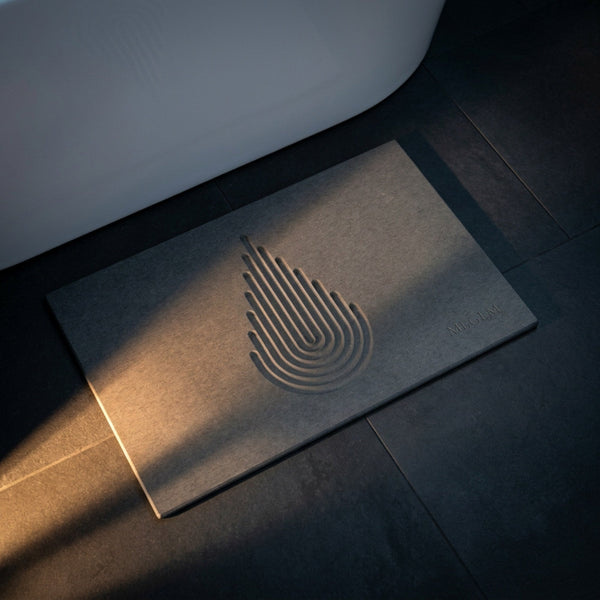
Mineral surfaces behave differently. Diatomaceous earth, the compressed silica of fossilized aquatic organisms, does not store water. The mineral moves it. The open-pore structure draws moisture inward through capillary channels, disperses it laterally through the mineral matrix, and releases it back as vapor through passive evaporation.
The surface does not saturate, retain, or accumulate.
Where textile holds water until conditions allow evaporation, a mineral surface completes the evaporative process itself, independently of heat, airflow, or time. The surface returns to dry within seconds of contact. The next person steps onto the same dry surface as the first.
Beyond convenience
The failure of textile in humid environments is not merely inconvenient. It represents a broader principle about material selection: the properties valued in one context do not automatically translate to another.
Softness and warmth are legitimate values in domestic materials. They are simply not the values that matter most when the primary function of a surface is to receive water and return to dry.
The bath mat is a functional object placed at the intersection of the body and water. It deserves a material that understands that intersection, one whose structure was shaped by water over geological time, rather than one that merely tolerates water until the next wash cycle.
A surface considered for water.